






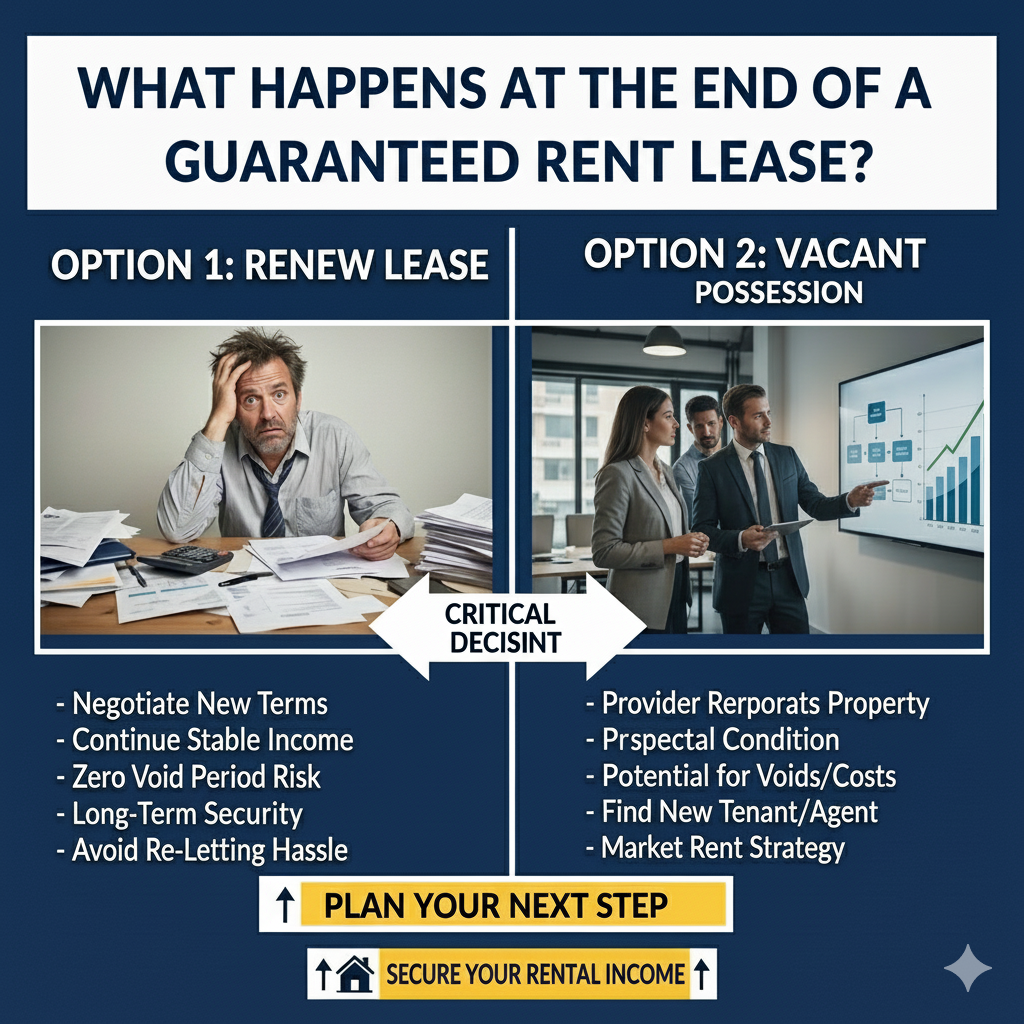
When a guaranteed rent lease reaches its end, landlords usually have the option to renew the agreement, review the terms, or take back full control of the property. Most landlords choose to renew because a guaranteed rent scheme continues to provide stable income without the risks of voids, arrears, or tenant management.

When a guaranteed rent lease approaches its end date, many landlords wonder what happens next. Unlike traditional letting arrangements, the process is usually straightforward. In most cases, landlords can renew the agreement, review the lease terms, or regain control of the property. For landlords who value stable income and minimal involvement, continuing with a guaranteed rent scheme is often the preferred option.
The end of a guaranteed rent lease does not usually mean disruption or uncertainty. Instead, it creates an opportunity to review the arrangement and decide the best next step for the property.
Most housing providers will contact the landlord several months before the lease ends to discuss renewal options. This allows both parties to review the agreement and confirm whether the partnership will continue.
Typically, landlords can choose between three options:
In our experience, the majority of landlords renew the lease because the stability of guaranteed income and reduced management responsibilities are difficult to replace with traditional renting.
Landlords who want to understand how guaranteed rent protects their income can also review our detailed guide here:
https://www.citywidehousing.co.uk/how-a-rent-guarantee-scheme-protects-your-rental-income/
A guaranteed rent lease provides something many traditional rental arrangements cannot — long-term financial stability.
When landlords move back to traditional letting after a lease ends, they often re-encounter common challenges such as:
Renewing a guaranteed rent lease allows landlords to continue receiving rent without these risks. The leaseholder remains responsible for the day-to-day operation of the property, while the landlord benefits from predictable income.
In addition, the demand for long-term leasing arrangements continues to grow as the UK rental market becomes more regulated. Housing standards and landlord responsibilities are increasingly defined by safety and compliance requirements set out by organisations such as the Health and Safety Executive, which oversees housing safety regulations in the UK:
https://www.hse.gov.uk/
Because of this, many landlords see lease renewal as a practical long-term strategy rather than returning to direct tenant management.
Although renewing a guaranteed rent lease is often straightforward, it is still important for landlords to review the agreement before committing to a new term.
Key areas landlords usually consider include:
Lease length
Some landlords prefer extending the lease for another long term, while others may choose a shorter renewal period for flexibility.
Rental income levels
Before renewing, landlords can confirm whether the rent level remains competitive based on the local rental market.
Property condition and responsibilities
Lease agreements normally define who is responsible for maintenance, compliance, and repairs. Reviewing these details ensures expectations remain clear.
Future investment plans
If the landlord plans to sell or refinance the property, it is important to understand how the lease structure may affect those decisions.
Professional landlord organisations such as the National Residential Landlords Association provide guidance on lease structures and landlord responsibilities in the UK rental sector:
https://www.nrla.org.uk/
Carefully reviewing the lease ensures landlords continue benefiting from the arrangement without unexpected surprises.
Renewing a guaranteed rent lease often becomes part of a landlord’s long-term rental strategy.
Instead of dealing with changing tenant situations, landlords can maintain a predictable income stream over multiple lease periods. This stability makes financial planning easier and reduces the uncertainty associated with traditional rental models.
From a portfolio perspective, long-term leasing also simplifies property ownership. Landlords spend less time managing day-to-day property issues and more time focusing on investment decisions.
In our experience, landlords who prioritise steady income and reduced stress often view guaranteed leasing arrangements as a long-term partnership rather than a short-term agreement.
At Citywide Housing Group, we remove the stress of compliance by:
Step 1: Get in Touch
Contact us today by phone or complete our online form to schedule a free, no-obligation property consultation.
Step 2: Property Assessment
We’ll visit your property to assess its condition, provide recommendations for any necessary improvements, and ensure it meets all required standards.
Step 3: Compliance & Handover
We manage the entire compliance process, carry out any necessary repairs, and arrange for an inventory check before officially handing over the property.
Step 4: Consistent Rent Begins
Once everything is in place, we take care of the property management, and you’ll start receiving consistent rent every month.
The end of a guaranteed rent lease is not a disruption — it is simply a review point for the landlord. Most landlords choose to renew because the arrangement continues to provide predictable income, reduced management responsibilities, and long-term rental stability.
If you want to explore whether a guaranteed rent lease could work for your property, speak to our housing team today for a free property assessment.
At Citywide Housing Group, we specialise in helping landlords secure guaranteed income with long-term leases. Our approach ensures:
Full Property Management: From tenant management to maintenance, we take care of everything so you don’t have to.
Compliance and Legal Support: We ensure that all your properties meet legal requirements and comply with housing standards.
No Hidden Fees: We believe in transparency, with no surprise costs—what we agree on is what you get.
Local Expertise: Our team is familiar with the Bradford housing market, ensuring you get the best returns for your property.
When a guaranteed rent lease expires, landlords usually have the option to renew the agreement, renegotiate the lease terms, or take back control of the property.
Yes. Most guaranteed rent leases can be renewed for another fixed term, allowing landlords to continue receiving stable rental income.
No. The landlord remains the legal owner of the property. The lease simply allows another party to operate the property while guaranteeing rent payments.
Yes. Many landlords renew because the arrangement provides consistent rent without the risks of void periods, arrears, or direct tenant management.
If you’re ready to secure fixed, reliable income with no voids or arrears, it’s time to join the growing number of landlords in Bradford benefiting from guaranteed rent schemes.
Contact Citywide Housing Group today to schedule your free property assessment and discover how we can help you unlock the potential of your property.
For more information, visit Citywide Housing or call us at 0113 323 0678.


Join our email mailing list to receive weekly tips, industry insights + more.

TL;DR When a guaranteed rent lease reaches its end, landlords usually have the

TL;DR Rising supported housing demand is influencing UK rental strategy, with landlords increasingly

TL;DR Many landlords choose long-term leasing over letting agents to secure stable income,
Fill out the form for a free consultation call and let us take care of your property, hassle-free.