






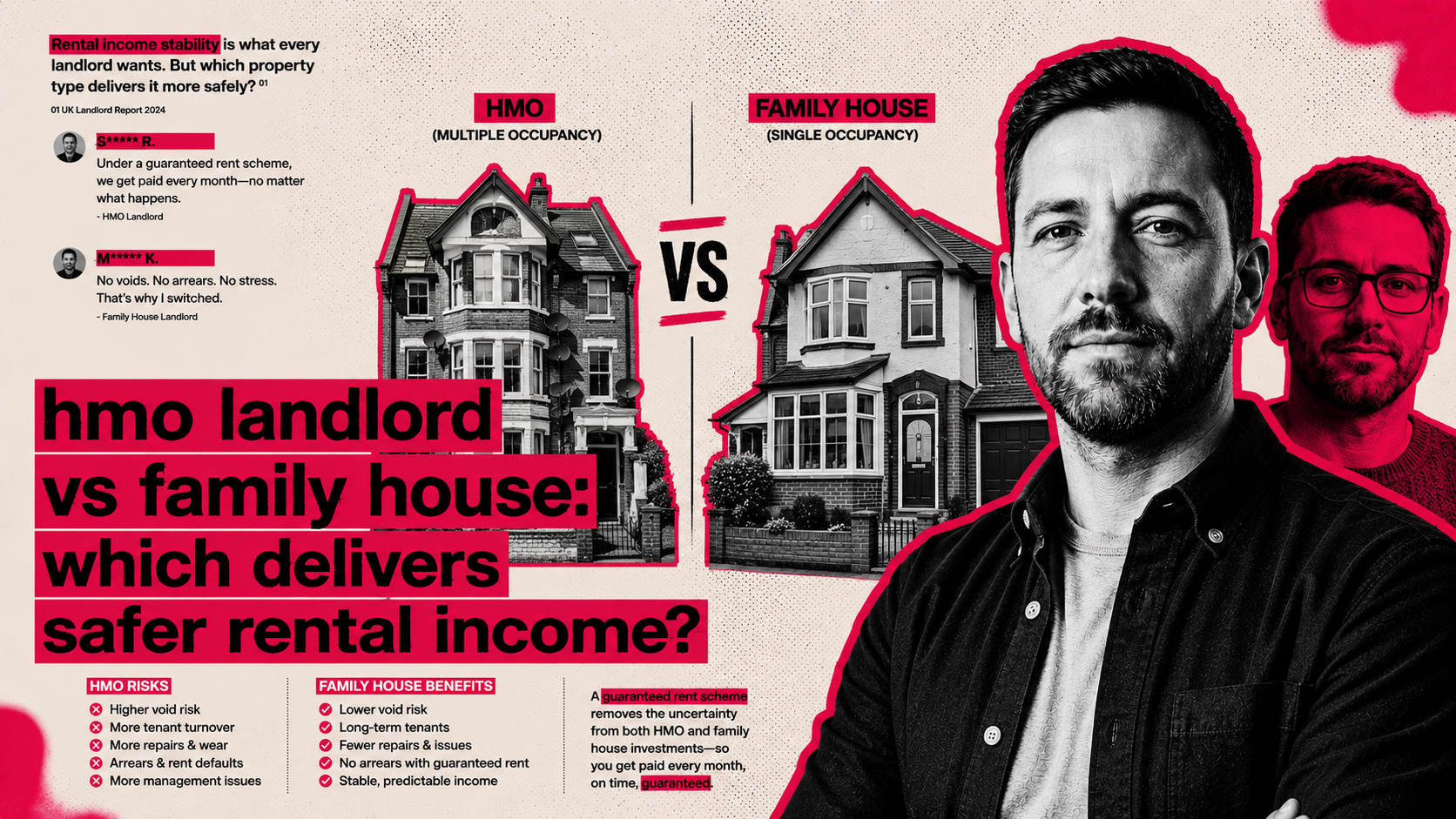
HMO landlord income can be strong, but it can also come with more management, room voids, compliance pressure and repair issues. Family houses may feel simpler, but they can still suffer from voids, arrears and tenant problems. For landlords who want safer and more predictable income, Citywide Housing’s guaranteed rent model can support both suitable HMOs and family houses through long-term commercial leases.

HMO landlord income can look stronger than family house income, but higher rent does not always mean safer returns. HMOs often involve more occupants, more compliance, more repairs and more room-by-room void risk. Family houses may be simpler to manage, but they can still create arrears, voids and tenant issues. The safer option depends on the landlord’s goals, property condition and preferred level of involvement.
For many landlords, the real question is not simply, “Which property earns more?”
The better question is, “Which property gives me more reliable income with less stress?”
Landlords often compare HMOs and family houses because both property types can work well, but they behave differently as investments.
An HMO may offer higher gross rental income because rent is usually collected room by room. A family house may offer a simpler management structure because one household usually occupies the property.
However, both models carry risk.
Landlords may face:
This is why landlords should compare real annual income, not only monthly rent.
A property with higher gross rent may not always deliver safer net income.
An HMO landlord can face higher income risk because there are more moving parts.
Instead of one household, an HMO usually has several occupants. This can increase both income potential and management pressure.
Common HMO risks include:
When every room is full and rent is paid on time, an HMO can perform well.
However, if rooms become empty or repairs increase, the income picture can change quickly.
An HMO landlord should look beyond headline rent because gross income does not show the full risk.
For example, an HMO may appear to earn more each month than a family house. But if the landlord has repeated room voids, high maintenance costs and more management time, the actual annual return may be lower than expected.
An HMO landlord should ask:
These questions help landlords understand whether the HMO is genuinely performing well or simply creating more work.
Family houses are often seen as easier to manage than HMOs.
This can be true, especially when one reliable household stays long term and pays rent consistently.
However, family houses still carry rental risk.
A family house landlord may face:
The main difference is that a family house usually has one income source.
If that household stops paying or leaves, the landlord may lose the full monthly rent.
So while family houses can be simpler, they are not risk-free.
The right property type depends on the landlord’s priorities.
| Area | HMO | Family House |
|---|---|---|
| Gross rent potential | Often higher | Often lower than HMO |
| Management workload | Usually higher | Usually lower |
| Void risk | Room-by-room voids | Whole-property void |
| Arrears risk | Multiple occupants | One household |
| Repairs | Often more frequent | Usually less frequent |
| Compliance | More complex, especially if licensed | Usually simpler |
| Tenant issues | Can be more frequent | Can be less frequent |
| Income predictability | Can fluctuate | Can be stable, but depends on tenant |
| Best for | Active landlords seeking higher gross rent | Landlords wanting simpler management |
This comparison shows why landlords should not choose a property type based only on potential rent.
They should consider risk, time and actual income received.
The safer rental income option depends on the structure behind the property.
An HMO may be safer if:
A family house may be safer if:
However, both can become stressful under traditional letting.
This is why some landlords prefer a guaranteed rent scheme. It can reduce the risk attached to both HMOs and family houses.
Guaranteed rent improves rental stability by giving the landlord an agreed monthly income under a commercial lease arrangement.
With Citywide Housing, suitable landlords can benefit from:
This can make both HMOs and family houses more predictable.
Instead of relying on individual occupants or one household paying rent, the landlord receives agreed rent under the lease.
For landlords who want fewer problems, this can be more valuable than chasing the highest possible rent.
For more information, visit:
https://www.citywidehousing.co.uk/guaranteed-rent/
Under a guaranteed rent model, the comparison changes.
| Area | HMO With Traditional Letting | Family House With Traditional Letting | Citywide Housing Guaranteed Rent |
| Income | Depends on room occupancy | Depends on household payment | Agreed monthly rent |
| Voids | Possible room voids | Possible full-property void | No voids |
| Arrears | Possible from occupants | Possible from household | No arrears |
| Repairs | Often landlord concern | Often landlord concern | No repairs |
| Tenant issues | Can be frequent | Can still happen | No tenant issues |
| Lease length | Often less predictable | Often less predictable | 3 to 5 year commercial leases |
| Landlord involvement | Usually active | Can be active | More hands-off |
This is why many landlords do not only compare HMO vs family house.
They compare traditional letting vs guaranteed rent.
Citywide Housing may consider both HMOs and family houses, depending on location, condition, compliance and housing demand.
A suitable property will usually need to be:
Citywide Housing works across key regions including:
Before any lease is agreed, the property will need to be assessed.
For landlord information, visit:
https://www.citywidehousing.co.uk/landlords/
Whether you own an HMO or a family house, you may need to provide key documents before the property can be leased.
These may include:
Having these ready can help the assessment process move more smoothly.
It also helps identify whether any work is needed before handover.
The process is designed to be clear for landlords.
A typical route may include:
This gives landlords a clear route from enquiry to lease.
It also helps landlords understand whether their HMO or family house is suitable before moving forward.
Guaranteed rent may suit landlords who want predictable income and less daily involvement.
It may be especially useful for landlords who are:
For many landlords, the aim is not to leave property investment.
The aim is to make the property easier to own.
An HMO can deliver strong rent, but it can also bring more management, room voids, repairs and tenant issues.
A family house may feel simpler, but it can still create uncertainty if the property becomes empty or arrears build up.
For landlords who want safer and more predictable income, the letting structure matters as much as the property type.
Citywide Housing offers suitable landlords guaranteed rent, market rents paid, no voids, no arrears, no repairs, no tenant issues and 3 to 5 year commercial leases.
If you own an HMO, family house, block of flats or suitable rental property, speak to the Citywide Housing team today for a free property assessment.


Join our email mailing list to receive weekly tips, industry insights + more.

TL;DR HMO landlord income can be strong, but it can also come with

TL;DR Guaranteed rent can help landlords with family houses secure fixed monthly income

TL;DR Supported housing can create strong long-term opportunities for landlords with suitable properties
Fill out the form for a free consultation call and let us take care of your property, hassle-free.